
When we walk, our attention naturally falls on the landscape around us. We notice the mountains, the rocks beneath our feet, perhaps a village in the distance or the remains of an old building beside the path. Every now and then, though, it's worth looking up.
On some of our walks around Teba, the Guadalhorce reservoirs and El Chorro, an enormous bird may appear overhead. Sometimes there is just one, while other times dozens may circle together, apparently hanging almost effortlessly in the sky. Very often the first question is simply: is that a vulture or an eagle?
In this part of Andalucía, the answer is often a Griffon Vulture.
Vulture or Eagle?
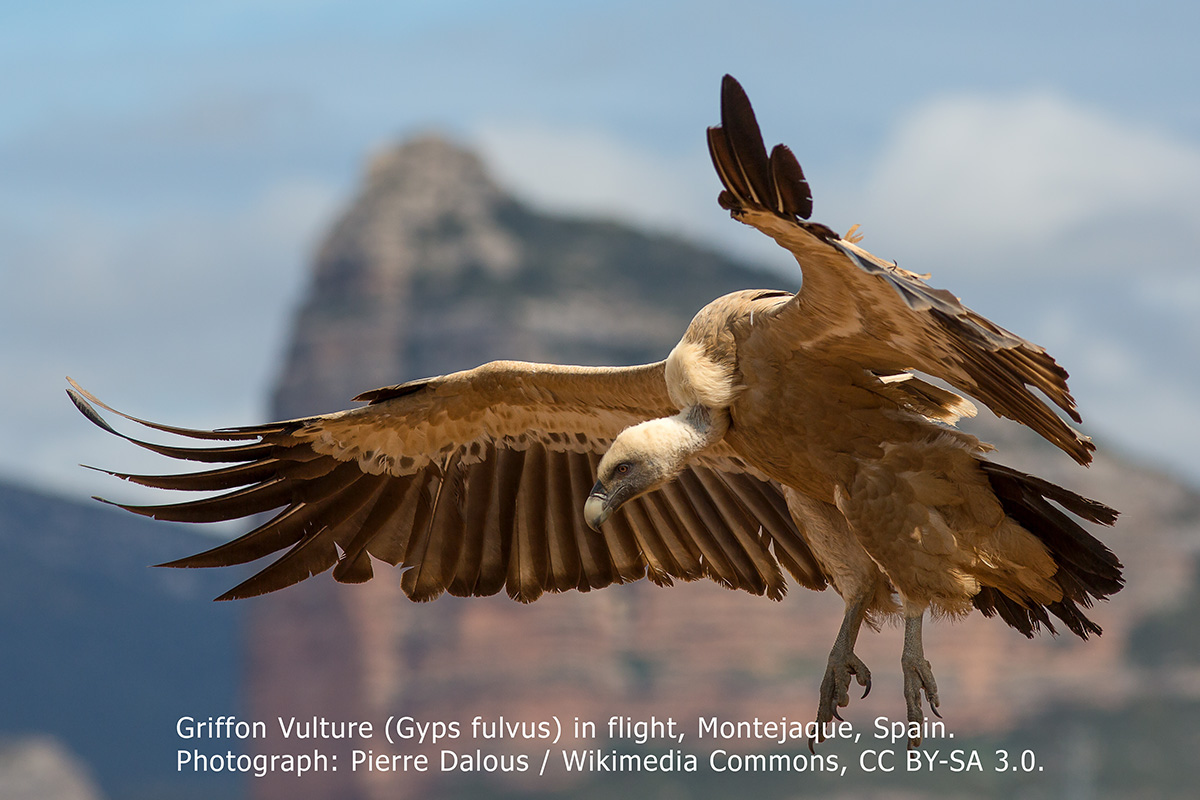
The Griffon Vulture is an enormous bird, with a wingspan that can reach around 2.6 metres. From high overhead, however, there may be little to give us a sense of that scale, so several other features can help with identification.
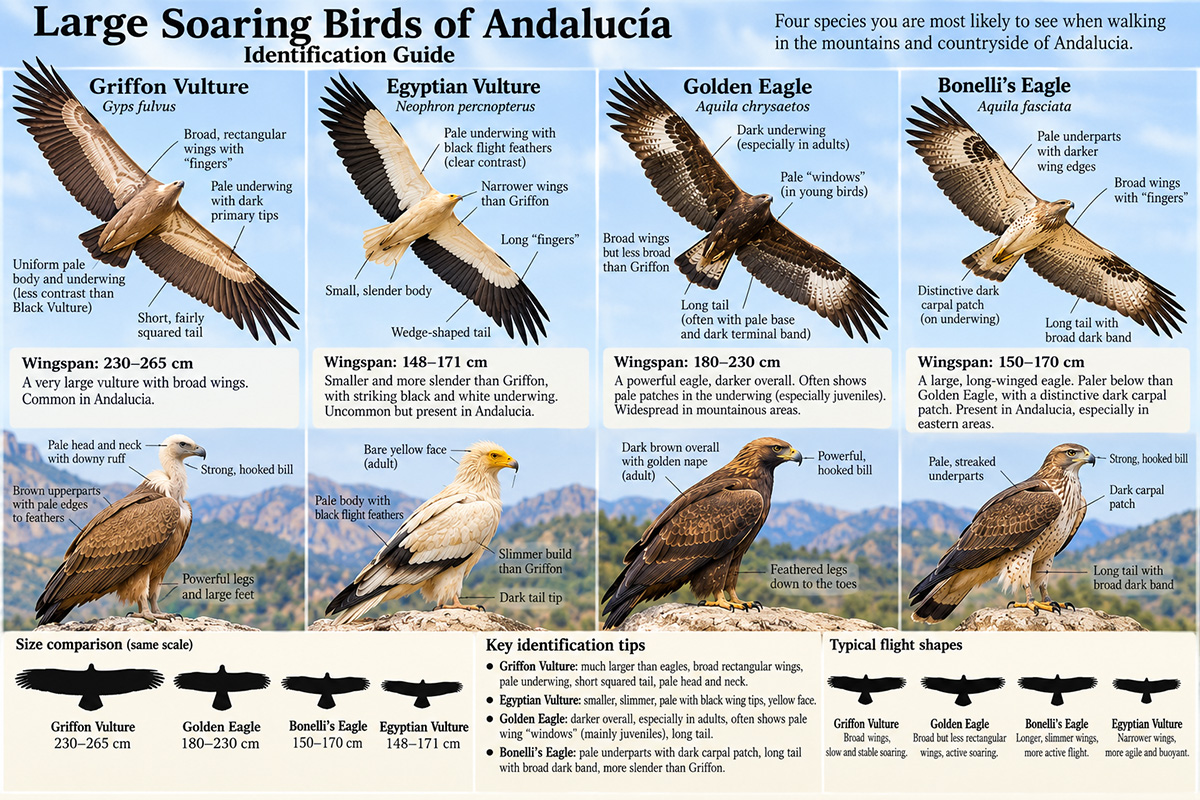
A Griffon has exceptionally broad wings, with long primary feathers that spread into obvious 'fingers' at the tips. The head looks surprisingly small in comparison with the body, and the tail is short. Seen from below, a noticeable contrast often appears between the paler underwing coverts and the much darker flight feathers.
Perhaps the most useful clue is the overall impression: huge, broad wings; a small-looking head; a stubby tail; and remarkably little flapping. Golden Eagles and Bonelli's Eagles also occur in Andalucía, and both can show fingered wingtips, so that feature alone doesn't make a bird a vulture. Looking at the tail, overall proportions, colour and behaviour gives us a much better chance of working out what we're seeing.
Built to Stay in the Air
Those enormous wings are fundamental to the way a Griffon lives. Unlike an eagle hunting live prey, a Griffon is overwhelmingly a scavenger, and its next meal might be many kilometres away. Searching for food by constantly flapping such enormous wings would use a tremendous amount of energy, so instead the bird uses rising air.
As the sun warms the ground, rising columns of warm air create thermals. A Griffon can circle within them, gaining height without flapping continuously. Once high enough, it leaves the thermal and glides across the countryside, gradually losing height until it finds another source of lift.
Mountains provide another opportunity. Wind striking a ridge or mountainside is forced upwards, creating slope or ridge lift that the birds can exploit. Griffons therefore aren't simply flying above the landscape. The ground, the mountains, the sun, and the wind help keep them aloft.
Searching a Huge Landscape
Efficient flight allows a Griffon to search an enormous area, which raises another interesting question: how does it actually find something dead?
European Griffon Vultures rely principally on exceptional eyesight, scanning the countryside below as they search for potential food. At the same time, however, they are also watching other Griffons. A bird suddenly descending toward the ground can provide useful information to others nearby, which may begin descending too and, in turn, attract the attention of birds farther away.
This means a group of Griffons spread across a large area can share information simply by watching what other birds are doing. This doesn't mean that every gathering of vultures indicates something dead on the ground. A large number spiralling upwards together may simply have found a particularly good thermal and be taking advantage of the same rising air.
Watching the direction the birds move can therefore tell us what may be happening. Birds climbing together are probably gaining height, while several birds deliberately dropping towards one location might suggest that something below has attracted their attention.
Why Here?
Griffon Vultures can be seen across a wide area, but the limestone landscapes of inland Málaga provide particularly suitable habitat. Places such as El Chorro and the Desfiladero de los Gaitanes combine extensive cliffs with open countryside, giving the birds suitable nesting sites and large areas to search for food.
Griffons commonly breed in colonies on cliffs, using ledges, shelves and cavities as nesting sites. A pair normally produces just one egg, with both parents investing heavily in raising the young. Some birds also show remarkable loyalty to the places where they were raised, eventually returning to breed on their natal cliffs and sometimes even using the same nesting sites.
That makes the limestone cliffs more than simply a convenient place for vultures to perch. A Griffon circling above El Chorro may be using cliffs where generations of the same population have nested and raised their young.
Living Alongside Vultures
Griffons have shared these landscapes with people and livestock for centuries. Traditional livestock farming provided carcasses, while the vultures formed part of a much wider scavenging community that also includes other birds, mammals, insects and microorganisms. By consuming carcasses, they perform an important natural clean-up role in the countryside.
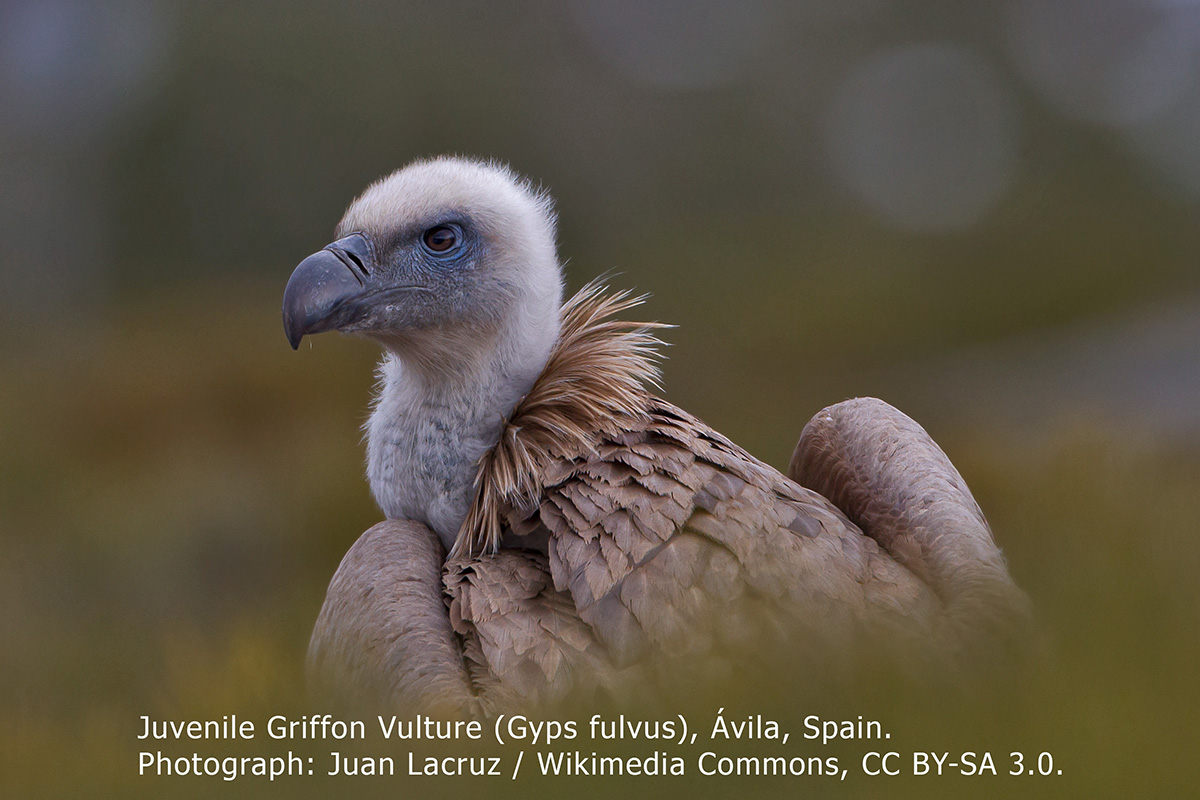
Despite their size, Griffons aren't built like eagles to kill and carry large prey. Their feet don't have the same powerful grasping role, and much of their anatomy is instead adapted to feeding on an animal that is already dead. Their long, relatively bare neck lets them reach deep into a large carcass, while the exposed skin also helps regulate body temperature.
Many of the features we notice when watching a Griffon therefore make sense when we consider the problem the bird has to solve. It needs to search enormous areas efficiently for food that is unpredictable and widely scattered. Its huge wings reduce the energy needed to travel, its eyesight helps it search the ground, other vultures provide useful information, and cliffs provide secure places to breed.
Look Up
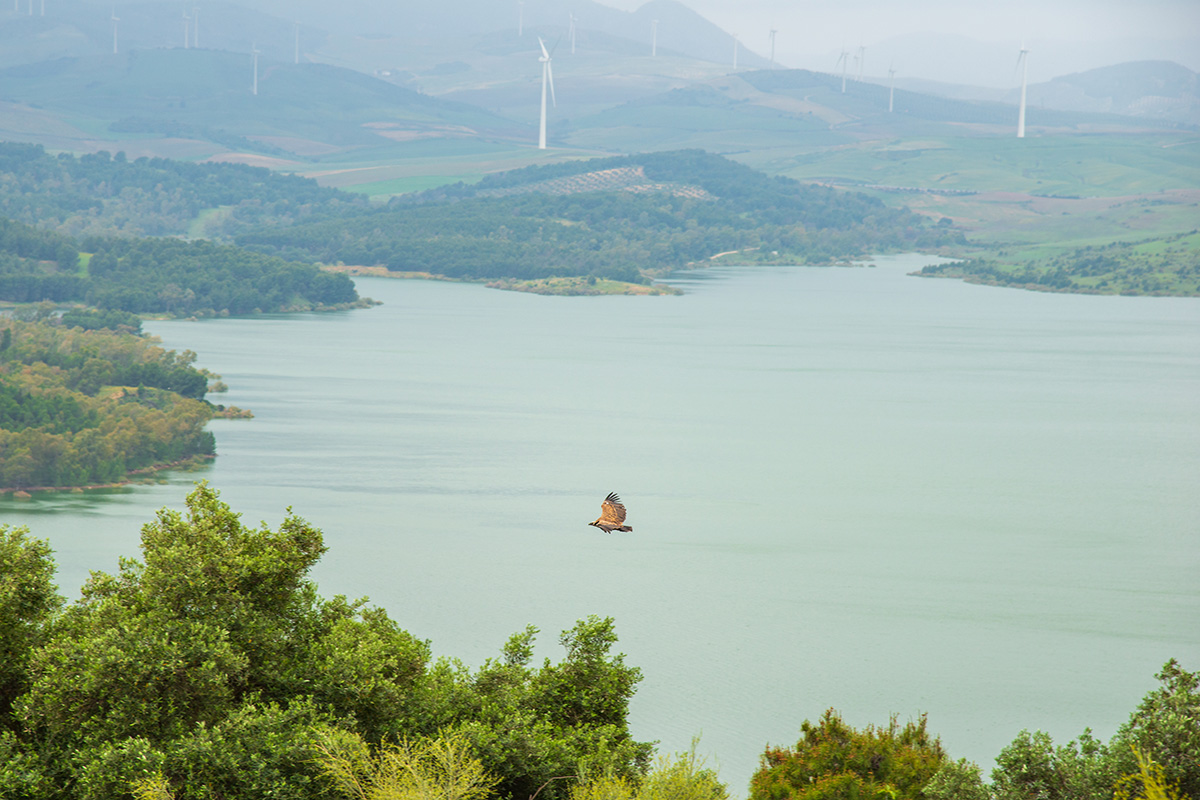
I've been fortunate enough to have some wonderful encounters with Griffon Vultures while walking in inland Málaga. On one walk around the Three Dams, birds passed perhaps 40 or 50 metres away, flying only just above treetop height. At that distance, their size was astonishing.
On another occasion in the same general area, I saw what genuinely appeared to be hundreds of vultures concentrated in the landscape. I still don't know exactly what had brought so many birds together. There may have been food on or close to the ground; they may have been gathering in particularly favourable rising air, or one may have led to the other. It remains one of those wildlife encounters that leaves you with a question rather than a neat answer.
Wildlife never works to an itinerary, of course, so seeing Griffons on a particular walk can never be guaranteed. But around Teba, the Guadalhorce reservoirs and El Chorro, they are very much part of the landscape we're walking through.
So while we're looking at the mountains, following the path, or admiring the view, it's worth occasionally taking our eyes off what's in front of us and checking the sky. We might just find one of Europe's largest birds quietly circling overhead.
